On this page we explore
- Sexism
- Gender stereotypes
- Masculinity and femininity
- Abuse against women and girls – examples of sexism and sexual abuse
- Violence against women and girls – helplines and support
- Useful links
What is sexism?
Sexism is treating someone differently or thinking they are less worthy, because of their sex or gender.
Often it is the idea that one gender is better than the other at particular things. These are gender stereotypes such as “girls are better than boys at looking after children, or “saying football is a men’s game!”.
Sexism can make you feel excluded or judged, or feel like you may not be good at something because of other people’s sexist views.
What are gender stereotypes?
Gender stereotyping is the belief that you must behave in a certain way and like certain things because of your gender.
An example of this is that ‘all girls like fluffy animals and all boys like dinosaurs because they are a boy’, when this is not true.
Gender stereotyping is a type of discrimination and can affect things like people’s freedom of expression and what clubs they are offered or what jobs they do.
In the UK around 7% of firefighters employed by the Fire and Rescue Service are women, and around 11% of registered nurses in the UK are men.
What is masculinity and femininity?
Masculinity is a set of stereotypes, behaviours or characteristics often associated with being a boy or man.
Some of these stereotypes include ‘being strong’, ‘dominant’ or ‘not asking for help’.
Toxic masculinity is when male stereotypes are taken to the extreme such as ‘taking control away from others’ or ‘not showing your feelings’.
Femininity is the name for a set of stereotypes, behaviours and characteristics that are often associated with being a girl or woman.
Some of these stereotypes include being ’emotional’ or ‘weak’.
The pressure to fit into this idea of masculinity or femininity can make people feel unhappy, uncomfortable or judged if they don’t act or look a certain way.
Sexual abuse against women and girls
Sexist abuse refers to the abuse people experience because of their gender.
Sexist abuse can be a form of sexual harassment. Sexual harassment is unwanted attention of a sexual nature that violates a person’s dignity, creates a hostile environment, or is offensive.
Sexist behaviour, includes disrespectful comments and sexist humour, and can be categorized as sexual harassment when it is unwanted and creates a hostile or intimidating environment. Sexist jokes, for example.
It can include emotional, physical, sexual and financial abuse and women and girls are often on the receiving end, although boys and men can also be affected.
Speak to someone – It is important to report it and seek the support you need find emotional wellbeing helplines.
Examples of sexism in school:
- “I come to school to learn and should feel safe but if I’m honest I really don’t feel safe.”
- “Women belong in the kitchen.”
- “Boys flicking girls’ bra straps… making inappropriate and uncomfortable comments about sex with girls in our year… groping/touching people at school without permission”
- “a teacher has said the reason why girls can’t play football is because it’s a boys sport”
- “Joking about rape” (this comment was mentioned multiple times)
- “I have received comments about my body that made me feel very uncomfortable”
- “I have also been asked out repeatedly by boys in my year who have then threatened to kill themselves after I said no multiple times”
Example of sexual harassment:
Advice if you are on the receiving end:
- Talk to someone – don’t keep it in.
- Challenge (if it is safe to do so) what people are saying so the language/behaviour is not normalised.
- Talk about the impact that abusive language has on Mental Health.
- We need to spread awareness and educate others so it is important to speak up about it.
Violence against women and girls
Women in the 16 to 34 years age group are twice as likely to experienced harassment.
Sexual Harassment is one of a number of offences that come under ‘Violence Against Women and Girls’ (VAWG).
“The UK government has labelled violence against women and girls as a national threat.“
Useful links
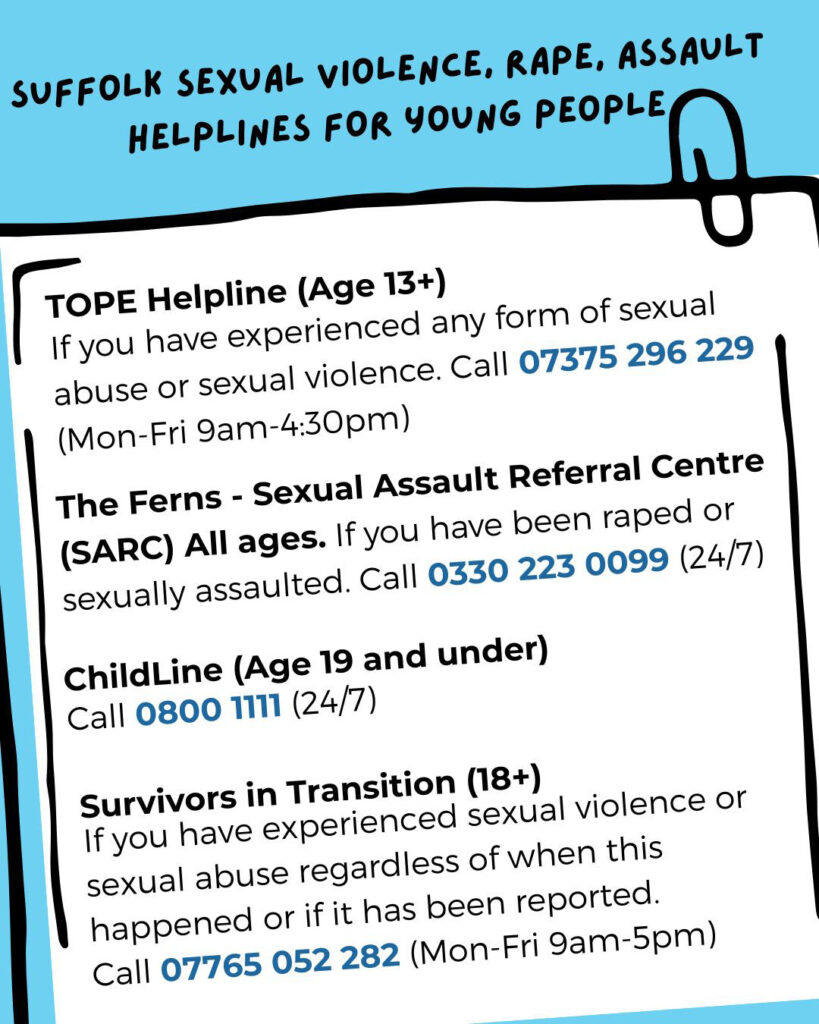
- Girls and young women can contact TOPE, The Ferns, ChildLine or Survivors in Transition for support if they have experienced sexual violence, rape or assault.
- Visit the ENOUGH. campaign page to find more support services or our Expert Directory
Page updated on March 5th, 2026 at 10:03am